
The printed circuit board (PCB) industry is entering a new phase of growth. For decades, PCB demand was largely driven by consumer electronics, computers, smartphones, and other high-volume products. Today, however, the center of growth is gradually shifting toward AI infrastructure, data centers, high-speed networking, automotive electronics, advanced computing, and other high-value applications. According to recent industry research from Prismark, the global PCB market reached approximately US$85.2 billion in 2025 and is projected to grow to around US$123.3 billion by 2030. AI infrastructure, data centers, networking equipment, automotive electronics, and advanced computing are among the major drivers of this growth.But the most important change is not simply the growth in market size. The PCB industry is becoming increasingly focused on higher performance, higher density, greater reliability, and more sophisticated manufacturing capabilities. So, what will shape the PCB industry over the next five years?
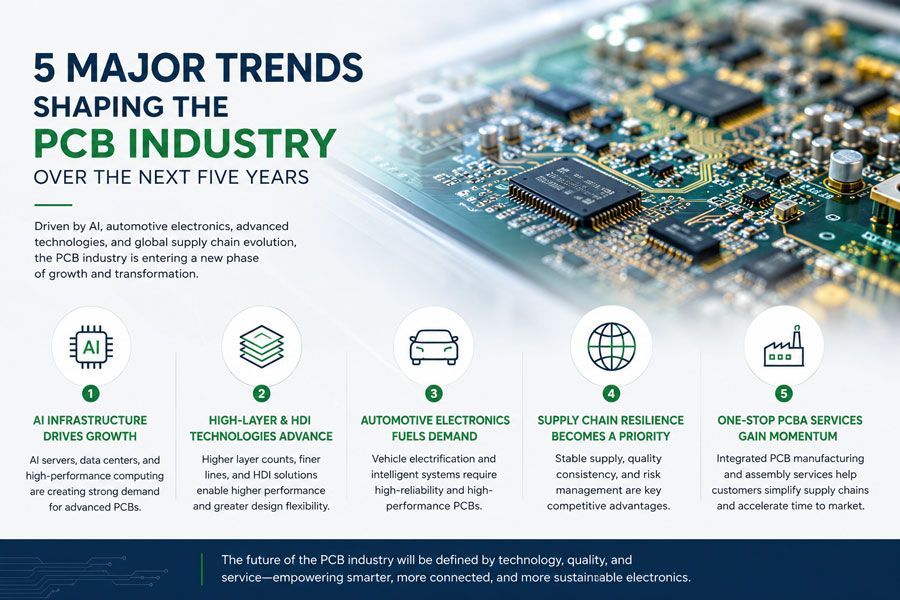
1. AI Infrastructure Will Become a Major Growth Engine for PCB Demand
Artificial intelligence is transforming the electronics industry—and PCBs are an essential part of the infrastructure behind this transformation. AI servers and high-performance computing systems require significantly higher computing power and data-transfer speeds than conventional servers. This is creating increasing demand for high-layer-count PCBs, HDI boards, high-speed materials, and advanced interconnection technologies. Prismark reported that strong demand from AI infrastructure helped drive the global bare-board PCB market to approximately US$85.8 billion in 2025. AI servers, high-speed networking, and advanced substrates were among the major contributors to this growth. AI data centers also require large, complex PCBs with higher layer counts and increasingly sophisticated interconnection structures.
This creates a clear shift in the competitive landscape: The future of PCB manufacturing will not simply be about producing more boards. It will be about producing more advanced boards with greater precision and reliability. For PCB manufacturers, investment in engineering capabilities, advanced equipment, process control, and quality management will become increasingly important.
2. High-Layer-Count PCB and HDI Technologies Will Continue to Advance
As electronic products become smaller while their computing and connectivity capabilities increase, PCB designs are becoming increasingly complex.High-layer-count multilayer PCBs and HDI (High-Density Interconnect) technology are particularly important for applications such as AI servers, networking equipment, telecommunications, automotive electronics, and advanced computing.
Prismark reported that 18+ layer multilayer PCBs were one of the fastest-growing PCB segments in 2024, while the HDI market also recorded strong growth. Demand was particularly strong for high-layer-count and HDI boards used in AI servers, high-speed networking, satellite communications, and other advanced applications. Over the next five years, PCB technology is expected to move toward:
- Higher layer counts
- Finer line widths and spacing
- Smaller microvias
- Higher routing density
- Better signal integrity
- More advanced build-up structures
- Greater control of impedance and electrical performance
This means PCB manufacturing will increasingly depend on engineering expertise and process capability, rather than production capacity alone.
3. Automotive Electronics Will Drive Demand for High-Reliability PCBs
The automotive industry is undergoing a fundamental transformation. Electric vehicles, advanced driver assistance systems (ADAS), intelligent cockpits, battery management systems (BMS), vehicle networking, and other electronic systems are significantly increasing the amount of electronics inside modern vehicles. As the electronic content of vehicles increases, so does the demand for PCBs. However, automotive PCB applications have different requirements from many consumer electronics applications. They typically require:
- High reliability
- Long service life
- Excellent thermal performance
- Consistent quality
- Resistance to vibration and environmental conditions
- Strict process and quality control
Market research also identifies automotive electronics as one of the important growth areas for the PCB industry, driven by vehicle electrification, ADAS, infotainment, and battery management systems. For PCB manufacturers, this means that quality systems, traceability, process stability, and reliability testing will become increasingly important.
4. Supply Chain Resilience Will Become a Competitive Advantage
Another major trend shaping the PCB industry is the changing structure of global electronics supply chains. In the past, manufacturers often focused primarily on production cost. Today, electronics companies increasingly consider a broader range of factors, including:
Cost + Quality + Lead Time + Supply Stability + Engineering Support
China remains the world’s largest PCB manufacturing base. Prismark estimates that China’s share of global PCB production could reach approximately 60% in 2026. At the same time, PCB and materials manufacturers are expanding capacity in Southeast Asia, including Thailand and Vietnam, as companies diversify their manufacturing footprints. For OEMs and electronics companies, supplier selection is therefore becoming more strategic. A reliable PCB supplier needs to provide more than competitive pricing. Customers increasingly value:
- Stable production capacity
- Reliable raw material sourcing
- Consistent quality
- Short and predictable lead times
- Engineering support
- Fast communication
- Flexible production capabilities
As supply chains become more complex, supply chain resilience itself will become part of a PCB manufacturer’s competitive advantage.
5. PCB Manufacturing Will Continue to Move Toward One-Stop PCBA Services
The final trend is not only about PCB technology. It is also about the way PCB manufacturers serve their customers. Traditionally, an electronics company might work with separate suppliers for:
PCB fabrication → Component sourcing → SMT assembly → Testing → Final assembly
Managing multiple suppliers can increase communication costs, production coordination, quality risks, and lead times. As a result, more electronics companies are looking for one-stop PCB assembly and electronic manufacturing services. A capable PCBA partner can integrate:
- PCB manufacturing
- Component sourcing
- SMT assembly
- DIP assembly
- Reflow soldering
- AOI inspection
- X-ray inspection
- Functional testing
- Final assembly
This model allows customers to simplify their supply chains and focus more resources on product development. For PCB manufacturers, this also means that the competitive boundary is changing. The question is no longer simply: “Can you manufacture my PCB?” Increasingly, customers are asking: “Can you support my entire electronics manufacturing project?”
What Will Define the PCB Industry of the Future?
The next five years will bring significant opportunities to the PCB industry, but market growth will not benefit every manufacturer equally. The strongest opportunities are likely to emerge in areas where PCB technology and manufacturing requirements are becoming more demanding.
AI infrastructure is driving demand for high-layer-count and high-speed PCBs.
Automotive electrification is increasing demand for reliable automotive PCBs.
High-speed networking is creating demand for advanced materials and better signal integrity.
HDI and advanced interconnection technologies are enabling increasingly compact and powerful electronic systems.
At the same time, global supply chain changes are encouraging manufacturers to build stronger production capabilities and more resilient supply networks. Ultimately, the PCB industry is moving from a cost-driven manufacturing model toward a technology-, quality-, and service-driven model. For electronics companies, choosing a PCB supplier should therefore go beyond comparing unit prices.
The more important question is: Can your PCB manufacturing partner support your product as it evolves? From PCB fabrication to PCB assembly, from prototypes to volume production, the ability to provide reliable engineering support, consistent quality, flexible manufacturing, and integrated supply chain services will become increasingly important. The future of PCB manufacturing is not simply about making more circuit boards. It is about making more advanced electronics possible. And the PCB manufacturers that can combine technology, quality, engineering expertise, and end-to-end manufacturing capabilities will be best positioned for the next stage of the industry’s growth.
About ABP Electronics
ABP Electronics provides integrated PCB manufacturing and PCB assembly services, supporting customers from PCB fabrication and DFM analysis to component sourcing, SMT assembly, testing, and final delivery. With a focus on engineering support, quality control, and flexible manufacturing, ABP helps electronics companies turn their designs into reliable, production-ready products.